Feeds:
Posts
Comments

last floorThe following text was written by James Jackson Jarves (1818–1888). This American newspaper editor and art critic visited Paris in the early 1850’s and published his impressions in Parisian Sights and French Principles, seen through American spectacles (1852). His humor and the clarity of his writing vividly portray the living conditions in mid-century Paris.

In a city where revolutions have become as periodical and necessary as measles, chicken-pox, and the whooping-cough to childhood, this species of architectural communism is very far from being a social one. No one knows his neighbor. There is no door-plate on the several landings, to satisfy curiosity as to who is to be found within. Somehow or other, the occupants never seem to meet on the common stairway. Of the seven families beside my own that occupied No. — of Rue de Foix six months, I knew nothing except that one was English, and another Russian. I could not have distinguished a single member of them all from a casual visitor. It is said that two friends lived for a year in the same house without being aware of the fact, until they accidentally met in the street, and inquired each other’s address.

The apartments usually taken by strangers, for limited periods, are let furnished with every necessary for housekeeping, except linen and silver, which are hired separately. Inventories are taken on entering and leaving; the lodger being responsible for all damage, other than ordinary wear and tear. These inventories embrace a list of existing damages, including grease and other spots on carpets, table-cloths, cracks or fractures in the glass or porcelain, all minutely detailed, as well as injuries to the furniture, &c. If any are added, they are to be paid for according to the tariff of the landlord, which is not of the most liberal character.

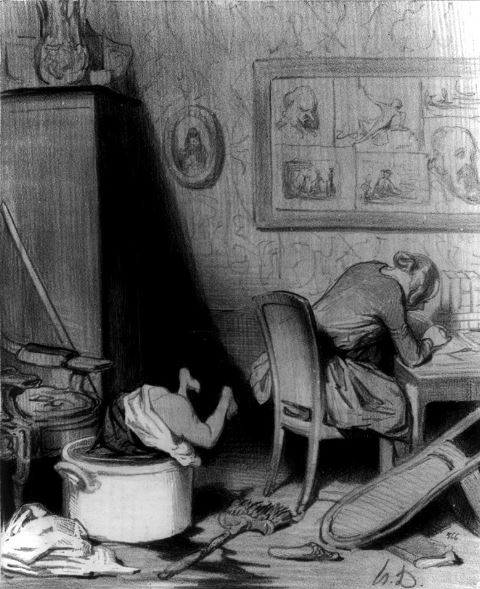
French kitchens are more like a ship’s caboose in size, than the domains of an American cook. What room there is, is mainly occupied by numerous little grates, raised upon a brick platform, and adapted in size to the various copper, “casseroles,” or saucepans, so necessary for the preparation of the indispensable “entremets,” of French cookery. A Yankee cook would be as much at a loss in one of these kitchens, as she would over a locomotive. One half of the ingenuities of our American furnishing warehouses would be equally as inexplicable to a French housekeeper. A good broom is not to be found in Paris. Carpets have been introduced into the apartments rented to English and Americans, but the French make but comparatively little use of them, preferring the waxed oak floors, which are cooler and cleaner, but require no little care, at first, for a stranger to preserve his equilibrium. The French use much less fuel than we, warming themselves more by extra clothing and foot-muffs, than by fires.

The search for apartments, which to a novice is a matter of amusement, soon becomes a fatiguing and embarrassing employment. He is ushered without ceremony into any which are taken for a short time, without regard to the convenience of the occupiers; led through disordered bedrooms, unarranged cabinets, and ushered into all the privacy of family matters, lucky for his and their modesty, if among the scattered articles of toilet, he does not pounce upon some fair one in matitutinal dishabille. At first, I hesitated upon these domestic thresholds, but the unceremonious “Enter, Sir,” soon convinced me that the right of the landlord to exhibit his apartments was superior to any considerations of delicacy. It was amusing to contrast the coolness and indifference with which French tenants underwent this scrutiny, often saying a word in favor of the lodgings or landlord, and always frankly courteous; whereas, with English or Americans, one was evidently looked upon as an intruder into their temporary castles, from room to room of which the ladies — like quails seeking cover — dodged about, to avoid meeting a man more frightened than they were themselves. Investigations in the unoccupied apartments are of course pursued under more favorable auspices. But, to believe the assiduous porters, there was not one that had a single fault, or wanted a single comfort, or even luxury. All of any pretensions had just been vacated by Russian princesses, or English “milords.” One proprietor, after a pompous eulogium on the merits of a spacious apartment, whose faded gilt furniture and tawdry splendor, seemed to have descended untouched and almost undusted, from the days of Louis XV., said, as a climax, “The Princess has just been to look at them, and was perfectly charmed; she wished to take them at once.” “Pray why did you not secure so noble a tenant?” ” Because she could not deposit the-required security for rent,” was the reply. Having just seen in the paper the arrest by the police of a Greek prince, for forgery, I came to the conclusion that the title “prince” was no better security for contracts or morals in Europe, than “colonel,” in the United States.

After ascending and descending, in the course of a month, perhaps a thousand pair of slippery stairs, and repeating the same questions, the lodging hunter growing desperate, affixes his signature to a paper, promising to pay from 100 f. to 1200 f. per month, in advance. In consideration of this sum, he finds himself, in one case out of two, in the possession of an apartment, in the inventory of which no mention had been made of smoky chimneys, and various facilities for the circulation of cold air, or odors which savor not of Araby the Blest, but which have now become his heritage for the period stipulated in the contract.

Related post: Paris in Winter – Not to be desired

Parisian house, January 1st, 1843

Parisian house, January 1st, 1845 – Click Ctrl+ to enlarge


The following text was written by James Jackson Jarves (1818–1888). This American newspaper editor and art critic visited Paris in the early 1850’s and published his impressions in Parisian Sights and French Principles, seen through American spectacles (1852). His humor and the clarity of his writing vividly portray the living conditions in mid-century Paris.

The different manner, in which the Anglo-American and the Gaul build their family nests, is pointedly brought home to the former the night of his arrival at Paris. We live in perpendicular strata; they in horizontal. Our houses stand side by side, each like a tub on its own bottom. Theirs, so far as they relate to families, are spread one upon the other, like a pile of gingerbread. With the exception of the principal hotels, and a few recently constructed in the English mode, Parisian houses are arranged after the following fashion. In general, they form a hollow square, allowing a court-yard of sufficient size for a carriage to turn. This shape admits of two ranges of apartments, equivalent in accommodations to houses with us; the one facing the street, the other the court-yard, the kitchen and other conveniences being the two connecting arms. Houses thus constructed accommodate two families on each floor, and are from five to nine stories high. The ground floor is devoted to shops, stables, and he porter’s quarters. It is entered by a huge “porte cochère,” which is always guarded by the family of the concierge, who acts as agent for the proprietors in letting their apartments, and watches all the outgoings and incomings of the mansion. Each range has its wide circular staircase for the gentry, leading as high up as what was once considered the only abode of genius, and another — small, dark, and narrow, like the worm of a ram rod — for the use of domestics. The porter must be on the ” qui vive” at all hours of the twenty-four, to slip back the bolt of the outer door, by means of a string connecting with his office, upon the warning ring or cry, ” Le cordon, s’il vous plait.” Those who enter after midnight, bestow a trifling gratuity upon this Argus, to compensate him for his disturbed slumbers. He replies to all questions relating to his charge, pays postages, receives and distributes all letters and parcels that have owners within his domain, uses your fuel as if it were his own, and is always ready to do the amiable — for a consideration. The floor above the entrance is called the “entresol,” being, as its name indicates, between sun and earth, and it is generally inaccessible to the former, at any season of the year, except in the widest streets or avenues. Being low, it rents low, compared with the floor above, which forms the apartment Number 1, in height, finish, and decoration, and is, consequently, much the dearest. They then progressively decline in price each story, and also in quality, until they terminate under the roof in a series of little chambers, for the servants of the mansion, two or more of these rooms belonging to each apartment. The apartments themselves are of every variety and size, to meet the wants of the diversified positions of the inhabitants of this metropolis. Some are of sufficient grandeur and sumptuousness to rival the interior of the more pretending hotels, while others dwindle to the means of the most economical bachelor or money-saving grisette.

This mode of building has some prominent advantages over ours. Externally the houses are more uniform, of greater size, and being built of a soft gray sandstone, admit of more architectural ornament. They economize also in ground-room and material, consequently in rent. All the rooms of a family being only one floor, much of that stair work of which our ladies complain, is saved. In enumerating these advantages, I have enumerated all, unless it may be considered one to be able to bring together the different branches of a family under one roof. Their disadvantages are more palpable. Each floor having its separate kitchen and drains, contributes its quota to an assemblage of odors, based upon the fragrance of shops or stables beneath, which, in spite of locks and bolts, penetrate with an impartial distribution into every room. This nuisance is not always perceptible, but it is a daily liability; and the plain truth is, that there are few of these gregarious habitations that do not give offense to sensitive nostrils more than once during every twenty-four hours. This fact has doubtless some relation to the enormous consumption of perfumery, which, not infrequently in the street, overpowers all other smells, as the scented individual goes by. Again, no amount of cleanliness in one story can always be proof against a want of neatness in the next. If one family cooks onions, the neighbors above and below are brought into unmistakable cognizance of the fact. If there be a frolic overhead, the family beneath participate in the noise, without the fun.

Next : Looking for an apartment in Paris

Related post: Where the Revolutionaries Lived by Mark Twain

Banquet des Maires 1900

Banquet des Maires

Who do you call when you need to throw a party for the Queen of England or the G7 summit? There is only one caterer that will do. The firm has a list of experiences reaching as far as 1856 on the occasion of the Prince Imperial’s baptism celebration. Potel et Chabot satisfied the demands of Napoleon III and since then they have been firmly established as the best in the world. In 1900, Potel et Chabot reached a culinary record that remains unsurpassed to this day. The legendary feast is known as the Banquet des Maires. Twenty-one thousand French mayors, including those from the colonies, responded to President Émile Loubet’s invitation to celebrate the success of the Exposition Universelle.

banquet cuisine

The area of the banquet in the Jardin des Tuileries covered 10,000 acres. 24,000 meals were served by the staff of 3,600. One car and six bicycles circulated between the tables to transmit orders. Over 6 miles of table-cloth was needed as well as 125,000 plates, 55,000 forks, 55,000 spoons and 60,000 knives. The nine-part menu was washed down with 39,000 bottles of quality wine including champagne. 3,000 bottles of gros-rouge were allotted to the perspiring staff.

Departure of guests

Departure of guests

I don’t know who paid the bill, but I bet that in today’s economic situation the question would be on every taxpayer’s lips.

A satisfied mayor

A satisfied mayor

Related posts:

Food: Not so good

The Scarcity of Water

Street People

One-man band

One-man band

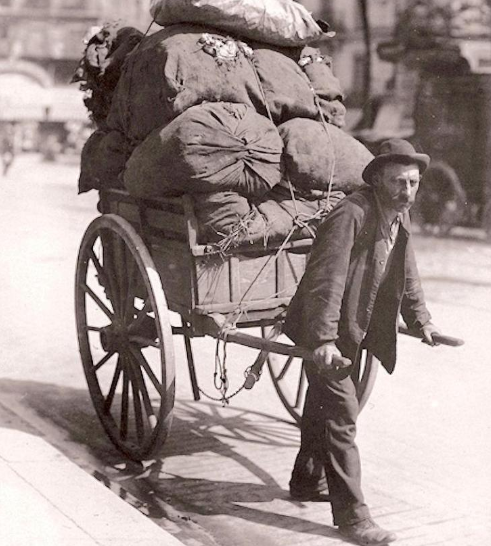
Kitchen ware supplier

Kitchen ware supplier

*

Cigarette butts picker

Cigarette butts picker

*

Pencil merchant

Pencil merchant


Related posts:

Parisians in 1842: The working class

Mark Twain and the Cancan


1840


The following text, published in 1842, offers an interesting look at the mid-19th century Frenchwoman and, surprisingly, at the French esteem of quietness:

A stranger would not appreciate the degree of praise which is contained in the word quiet when used by the French, who appear to consider it as comprising all the cardinal virtues; when seeking a house or apartments, if you say anything favourable or unfavourable of them, they never fail to remind you that they are so quiet. The same eulogy they will pronounce on their daughters with peculiar pride and energy, when they wish to extol them to the skies, and in good truth their demoiselles are quiet enough in all conscience, for it requires often a considerable degree of ingenuity to extract from them more than monosyllables. We have been accustomed to consider the French as a restless, capricious, volatile people, and so I suppose they might have been formerly, but now they are undoubtedly the reverse, being a quiet routine plodding sort of people, particularly as regards the provincials; and even amongst the Parisians there are thousands that reside in one quarter of the city, which they seldom quit, never approaching what they consider the gay portion of Paris, but live amongst each other, visiting only within their own circle, consisting almost entirely of their relations and family connexions.

The women consider, even down to a housemaid, that their sex demands a certain tone of deference, however humble their position, and if a nobleman did not touch his hat to them when they open or shut the door for them, with the usual salutation of good day or good morning, they would pronounce his manners brutal, and say, that although he was a man of title he was not a gentleman; hence the very unceremonious manner that an Englishman has of addressing servants, whether male or female, has kept them very much out of favour with that class of the French community. A scullion, or what may be termed a girl of all work, that has not met with that degree of respect from some of our countrymen to which she considered herself entitled, will remark, that the English may be very rich, but they certainly are not enlightened as we are, with a little drawing up of the head, implying their consciousness of superiority over us semi-barbarians; your charwoman, your washerwoman’s drudge, fish woman, or girl that cries turf about the streets, are all Madame and Mademoiselle when they speak of each other, and with them there is no such word as woman; if a female, she must be a lady, even if her occupation be to pick up rags in the street.

Source:

HOW TO ENJOY PARIS IN 1842,

INTENDED TO SERVE AS A

COMPANION AND MONITOR

Indicating all that is useful and interesting

IN THE FRENCH METROPOLIS,

Containing

HISTORICAL, POLITICAL, COMMERCIAL, ARTISTICAL, THEATRICAL AND STATISTICAL INFORMATION.

AS ALSO A DESCRIPTION

Of the manners and customs of the Parisians of the present day;

WITH INSTRUCTIONS FOR THE STRANGER.

In Respect to Economy, and Advice to his general proceedings with the French.

By F. Hervé

Author of A Residence in Turkey and Greece, etc, etc.


 Related post: Mending their manners

The Worst Season in Paris


bouchee de pain


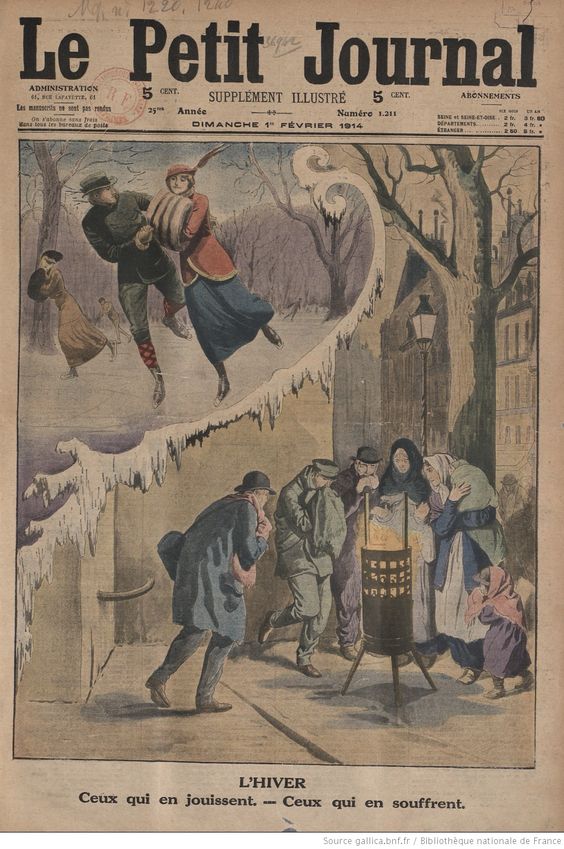
In Paris in the Winter: Not to be desired, published during the cold days last year, we could read the complaints of an American traveler written in 1854. In 1899, nearly half a century later, little had changed.  With the high prices of wood and coal, and drafty dwellings, Paris remained inhospitable in the cold months and, for the poorest, a charitable bowl of soup was the only warmth they could expect:

The Parisian winter is an institution of which no good can be said. The tremendous, arctic cold of the United States is almost unknown, as is also the beautiful, clear, frosty weather; in their stead come an almost endless succession of gray, misty, unutterably damp days, with a searching, raw cold that penetrates even to the dividing asunder of bone and marrow. The dearness of fuel, and the totally inadequate heating arrangements in most houses, add to the cruel discomfort of this season, in which the poor always suffer greatly. The number of unemployed is always large, and among them are frequently to be found those accustomed to the comforts and refinements of life. A recent article in a Parisian journal describing the charitable distribution of hot soups by the organization of the Bouchée de pain [mouthful of bread] cites the instance of a lady among these applicants, so well dressed that the attendant thought it right to say to her: “Have you come through simple curiosity, madame? In that case, you should not diminish the portion of those who are hungry.” The lady answered simply: “I am hungry.” It appeared that she was an artist, had exhibited twice in the Salon, and yet was reduced to this necessity. This charitable organization is distinguished from most others by the fact that it asks no questions and imposes no conditions on those who come to it for aid. Consequently, its various points of distribution are crowded with long lines of the shivering and famished, and the smallest offering from the charitable is thankfully received.

Paris from the Earliest Period to the Present Day; Volume 1, by William Walton, text published in 1899

 Related posts (tagged Public Works and Services):

Parisian Foundlings

The Government of Paris: A success story


The-Greater-Journey“When good Americans die, they go to Paris,” Oscar Wilde said. The old love affair between Americans and the City of Lights seems to go on and on.  Thomas Jefferson and Benjamin Franklin were among the early birds, but the popularity of Paris as a destination peaked in the second half of the 19th century when sea travel became faster and more comfortable. By 1870, twenty thousand Americans settled in Paris for a prolonged sojourn or made the city a permanent home. Thousands more passed through each year as tourists and gathered knowledge of how things were done the French way – for better or worse.

The Greater Journey by David McCullough paints in detail this great experience of Americans in Paris and its profound influence on the development of American art and sciences. The book is eminently readable and enjoyable. McCullough achieved a panoramic view on the different personalities moving in different circles yet connected through the same goal: to learn and absorb new ideas. The Greater Journey reads like Who is Who in American art, science, medicine and technology. No other book offers such a clear understanding of the dynamics in 19th century Paris.

paris i love youAre Americans still in love with Paris? They are, to be sure, until they actually go there to live. Like their ancestors, many publish books about their experience. Some maintain their enthusiasm, at least in their writing, but others question the benefits of living in today’s Paris. These past two hundred years, America has made a giant progress in art and sciences and now she can teach rather than to be taught. Under these circumstances, how does the beauty and excitement of Paris weigh in the balance with its various inconveniences? Is it worth it?

Rosecrans Baldwin answers this question in his book Paris, I Love You but You’re Bringing me Down. His one-year chronicle of functioning in an upscale advertising agency shows the bumpy road an American has to travel while working and living in Paris.  Just trying to figure out the kissing protocol in the office is a headache: who of your co-workers do you greet with kisses and who do you not?  (They won’t tell you.) This, and other tricky rules, as well  as the city services interruptions, and a lot of red tape in daily life, quietly nibble at your enthusiasm until there is little left. Paris I Love you but… contains many deep insights served with gentle humor.

Related posts:

Mending their Manners

Clever and Bizarre Local Items

Follow

Get every new post delivered to your Inbox.

Join 46 other followers